Mirror vs Camera: Why Your Skin Can Look So Different in Selfies
One harsh photo is not automatically a more truthful view of your skin. Distance, light, camera processing and perspective can all change what becomes visible.
The camera is not a truth machine
A familiar experience goes like this: your skin looks normal in the bathroom mirror, then a phone photo suddenly appears to reveal every pore, patch of redness, under-eye shadow and tiny bump. The natural reaction is to trust the photograph because it feels more “objective.” But a camera is not a neutral witness. It is a measurement system with a position, a lens, a light source and a processing pipeline.
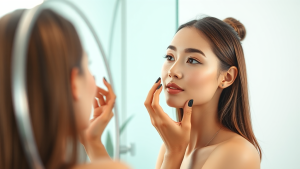
A mirror gives a live, reversed view while you move through slightly different angles. A photo freezes one moment and then turns sensor data into an image using exposure, white balance, sharpening, tone mapping and compression. Neither view is perfect in every condition. The useful question is not which one is “the real you,” but which setup is repeatable enough to judge change.
Distance can change facial proportions
Close selfies are especially poor baselines. Research on short-distance photography has repeatedly shown that camera position changes apparent facial proportions. In a 2024 study, Derakhshan and colleagues photographed people at multiple distances with both a smartphone and a full-frame camera. At short selfie distances, measurable distortion of midfacial features appeared.
That finding does not mean a close camera creates real skin texture. It means the geometry of a close photograph is different from a portrait taken farther away. If one comparison photo is held 20 centimetres from the face and the next is taken from more than a metre away, apparent changes in facial shape can overwhelm the subtle skin differences you were trying to judge.
Lighting changes the micro-shadows you see
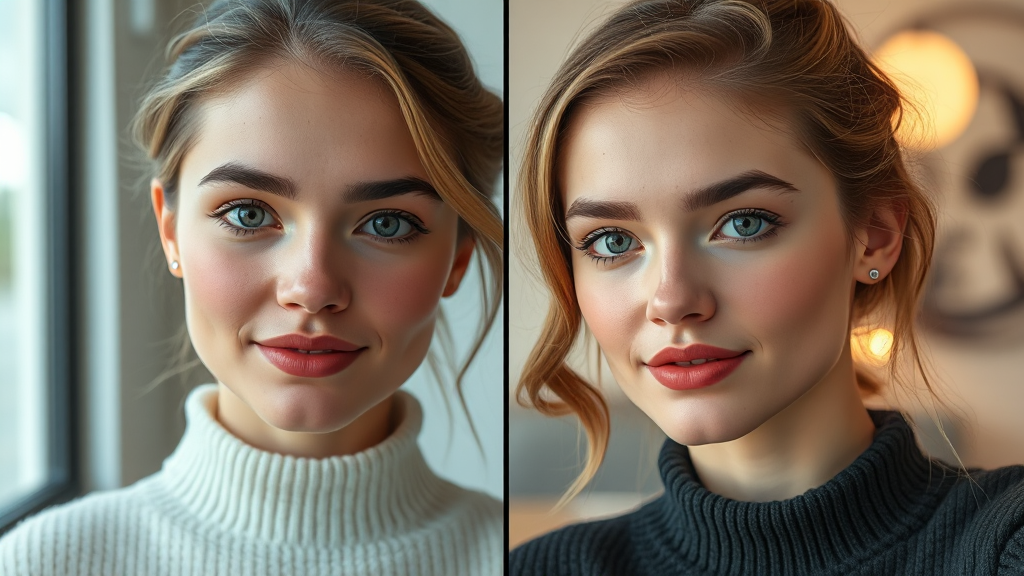
Skin is a three-dimensional surface. Pores, fine lines, flakes and small bumps create tiny changes in height, and directional light can turn those changes into visible shadow. Soft frontal light fills many of those micro-shadows. Light from above or strongly from one side can make them much more obvious.
The effect is not just anecdotal. Hernandez and colleagues photographed 51 people under standardized conditions while changing only the angle of the light. The study found that lighting angle could change aspects of how faces were perceived. It was not a skincare study, but it demonstrates why “same person, different light” is not a trivial difference when evaluating a photograph.
Colour and brightness can shift too
Phone cameras also make decisions about colour. Auto white balance estimates the colour of the light and adjusts red, green and blue channels. Exposure decides how bright the final image should be. HDR may brighten shadows or compress highlights. Sharpening can raise local contrast around existing edges.
Cronin and colleagues tested smartphone photography of standards representing diverse skin tones. Camera angle affected measured colour and lightness, while distance affected lightness. The study used colour standards rather than faces, so it should not be stretched into a claim about every selfie. Its practical lesson is simpler: inconsistent camera geometry adds variability to photographed skin appearance.
The mirror is familiar; the photo may not be
A second source of discomfort is orientation. You see your mirror-reversed face every day. A rear-camera photograph usually shows the left-right orientation other people see. Normal asymmetries swap sides, and the unfamiliar version can feel “wrong” even though nothing about the face changed.
That unfamiliarity is another reason not to use emotional reaction as a measurement. A picture can surprise you without revealing a new skin problem.
Use one bad selfie as a clue, not a verdict
Before buying another cleanser, exfoliant or serum because of one photograph, reproduce the conditions. A deeper guide to
why skin can look worse in photos is useful here because it separates camera variables from signals that persist across matched images.
If a patch of redness disappears when you move from mixed indoor lighting to soft daylight, the original photo exaggerated a colour difference. If a shadow appears only under overhead light, it is partly a lighting effect. If the same mark remains in the same place across several controlled photographs, it is more reasonable to track — although a photo still cannot tell you the medical cause.
A 90-second fair-photo protocol
Use the phone’s main camera rather than an ultra-wide lens. Put the device at eye level on a stable surface and step back roughly one to one-and-a-half metres, then crop rather than holding the camera close. Face a large window in indirect daylight. Turn off flash, beauty filters and portrait effects. Keep the expression neutral and use the same camera app each time.
Save the original file. Social-media uploads, screenshots and messaging apps can apply additional processing or compression. For progress photos, write down the approximate distance and location so you can recreate them later.
Do not overhaul a routine because the camera had a bad day
The most expensive mistake is treating a capture artifact as a skincare emergency. If a face suddenly looks rougher, redder or shinier in one image, first test the camera conditions. Reproduce the photo with neutral light and a repeatable distance. Only then decide whether there is a stable visual pattern worth following.
When a concern is painful, rapidly changing, bleeding, persistently irritated or otherwise symptomatic, a clinician is more appropriate than a photo comparison. Cameras can document visible change; they cannot take a history, examine skin from multiple angles or make a diagnosis.
The practical takeaway
The mirror and camera are different viewing systems, not rivals competing to reveal a hidden truth. For appearance tracking, consistency matters more than intensity. A boring, repeatable image taken from the same distance in the same light is far more informative than a dramatic close selfie.
If a photo makes you want to change everything, change the photo conditions first.
References and further reading
• Derakhshan et al. — Quantifying Facial Distortion in Modern Digital Photography — Laryngoscope, 2024.
• Cronin et al. — Effect of camera distance and angle on color of diverse skin tone-based standards in smartphone photos — Journal of Biophotonics, 2023.
• Hernandez et al. — The Influence of Different Light Angles During Standardized Patient Photographic Assessment on the Aesthetic Perception of the Face — Aesthetic Plastic Surgery, 2021.